
Fairfax City Property Value Types
Fairfax City property records can hold a tax assessment, sale information, and parcel characteristics. The assessment office values property at 100 percent of fair-market value as of January 1. A sale price is the consideration in a transaction, and a market estimate is an opinion about likely value under a set of assumptions. These figures can differ because they are created for different reasons and on different dates.
| Value | What It Is | Where |
|---|---|---|
| Assessed value | Annual tax valuation effective January 1, set at full fair-market value | City Real Estate Assessments |
| Market value | An estimate of likely value; the assessment method is not a sale appraisal | Assessor methods or a licensed appraisal |
| Last sale price | Consideration tied to a recorded transaction, if available | Deed image or assessment transfer record; exact fields not confirmed |
| Land and improvement split | Separate component values if shown on the current parcel card | Assessment system; live card not captured |
Fairfax City assesses at 100 percent of fair-market value. Even so, an assessed figure is not identical to any particular sale. The assessment date, the information the assessor had, and the property's condition can all pull the numbers apart. Each transaction's terms can too. When comparing figures, pair every value with its tax-year label and the deed's recording details.
Find a Fairfax City Assessed Value
The city assessment page links to a property database searchable by address. Open the parcel card there. Confirm the tax year before relying on any figure. That assessment portal is the authoritative public starting point for a Fairfax City tax value.
- Search the property address in the Real Estate Assessment Database.
- Copy the displayed assessed value and the tax year that applies to it.
- Note any land or improvement values only if the current card displays them.
- Find the latest sale instrument through the Virginia SRA land index and compare dates and descriptions.
- Use a qualified appraiser for a current market opinion when a sale or financing decision depends on value.
- Assessed value
- The city's annual tax value for the parcel.
- Market value
- An estimate of exchange value; the assessor uses mass-appraisal methods.
- Consideration
- The value or price stated in a recorded transaction; exact public fields were not confirmed.
- Reassessment
- The yearly process that produces a new value effective January 1.
Fairfax City January Reassessment
Real Estate Assessments sets values every year, effective January 1. Fairfax City keeps its tax roll at 100 percent of fair-market value. Depending on the kind of property, the office applies a comparable-sales, income, or cost approach. That work covers the whole roll. It is not an appraisal of one home.
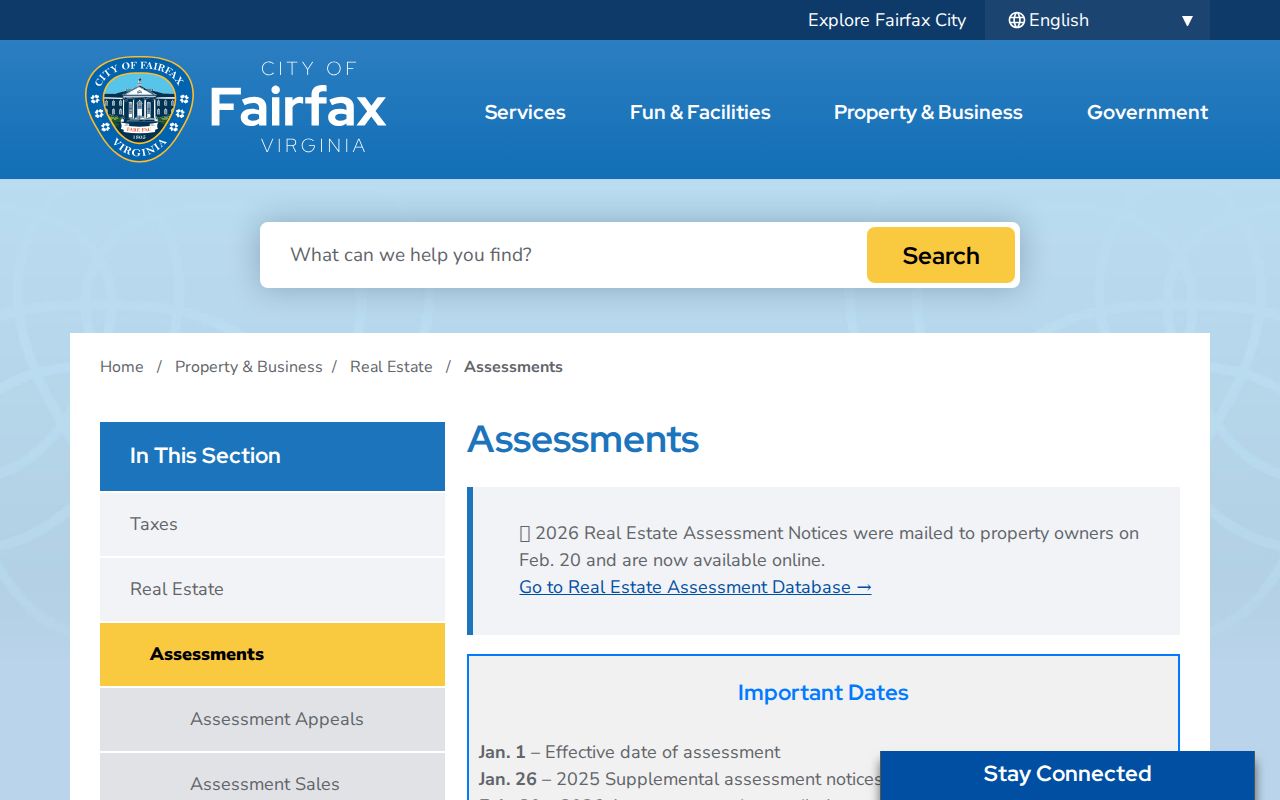
A value should always carry its year. The 2026 notices were mailed February 20. They also became available online. A sale after the effective date may not appear in the earlier value, and a later deed can reach the Clerk's index before the roll catches up. The city publishes no fixed update lag, so track the recording date alongside the assessment year.
Fairfax City Land and Building Values
Some assessment systems split a parcel's value into land and improvements. Improvements means the buildings on the land. Not every card shows this split. Fairfax City's live parcel card display varies, so do not count on the same fields for every parcel.
If separate amounts appear, write down the total and the year along with the components. A shift in the building portion may reflect new assessed characteristics or a change in the parcel record. Use the city assessment page for the official entry. Ask the assessor about unclear or missing fields. The Fairfax City assessment page links to the database.
Pull the exact parcel ID from the city system. That keeps every land and building value tied to the right piece of Fairfax City property.
Fairfax City Sale Price in Deeds
A recorded deed may state the consideration paid. Fairfax City publishes no assessment field that reliably shows a last sale price. Search the latest transfer in SRA instead. Open the deed image itself. Compare the instrument date, the parties, and the complete legal description.
Never read a deed's stated consideration as a guarantee of current value. A transaction can carry terms or circumstances unlike a typical open-market sale, and a prior price belongs to its own date. Record the deed reference as the source. An old consideration figure is not a present appraisal. For document types and copy access, see the Fairfax City deed-record information.
Fairfax City Value and Tax Rate
An assessment is one input to a tax bill. It is not the tax rate. City Council sets the rate. The Treasurer then sends the bill and keeps the record of each payment. The assessment page lists an example rate of $1.0725 per $100, but check that figure against the current bill year. Exemptions and relief can change taxable exposure without touching the market value or the recorded sale price.
The distinction matters when you compare a value record with a payment. A higher assessment does not prove what is owed. The tax bill and the payment account answer that. The Fairfax City property tax records page covers the bill, relief, and the appeal route.
Fairfax City Value Context by Year
Census QuickFacts reports a median owner-occupied home value of $722,600 for 2020 to 2024. The city's 2026 Fact Book lists 26,340 residents, drawing on a 2024 source. QuickFacts estimates 26,772 residents for July 1, 2025. These come from different sources and years. Do not merge them into one trend.
Broad measures give neighborhood context only. They say little about one house. A single Fairfax City property value depends on its parcel, condition, use, assessment year, and transaction history, so citywide housing numbers cannot replace a comparable-sales review or the actual parcel record. The Census QuickFacts profile publishes the citywide housing and value measures with their source periods.
Fairfax City Historic Property Context
Fairfax City values can shift block by block. History explains part of that. In Old Town, contributing properties date from 1800 through the 1930s. The courthouse-centered grid still carries long, narrow lots. Those older parcels often appraise differently from newer stock nearby. Planning lenses add another layer of context.
Northfax, Kamp Washington, and Fairfax Circle are adopted activity-center overlays. Old Town serves as one too, under city plans. A GIS map of these layers shows public projects, street changes, and redevelopment pressure. Each sits in relation to a parcel. Pull the assessment parcel and recorded plat alongside the GIS layer. Then check current planning documents for any overlay or project that touches the property.
Note: A map is not an appraisal, and a historic designation alone sets no price.
These property records describe context, nothing more. A professional valuation still turns on condition, terms, and market proof. Use the parcel, plat, and planning files to frame that conversation.
Limits of Fairfax City Property Value
Treat the assessment as a mass-appraisal tool for tax administration. It is not a promise of market price. Timing and condition both matter. Transaction terms matter too. The model's underlying data can push an assessed value away from an arm's-length sale. Fairfax City updates the assessment each year. The city publishes no fixed post-sale lag for the tax roll. For a real decision, bring in a licensed appraiser. A sale or a loan also calls for a property-specific opinion of value.
Value vs price. A Fairfax City assessed value is not a guaranteed sale price or a private appraisal. Use a licensed appraiser when a decision requires a current market opinion.